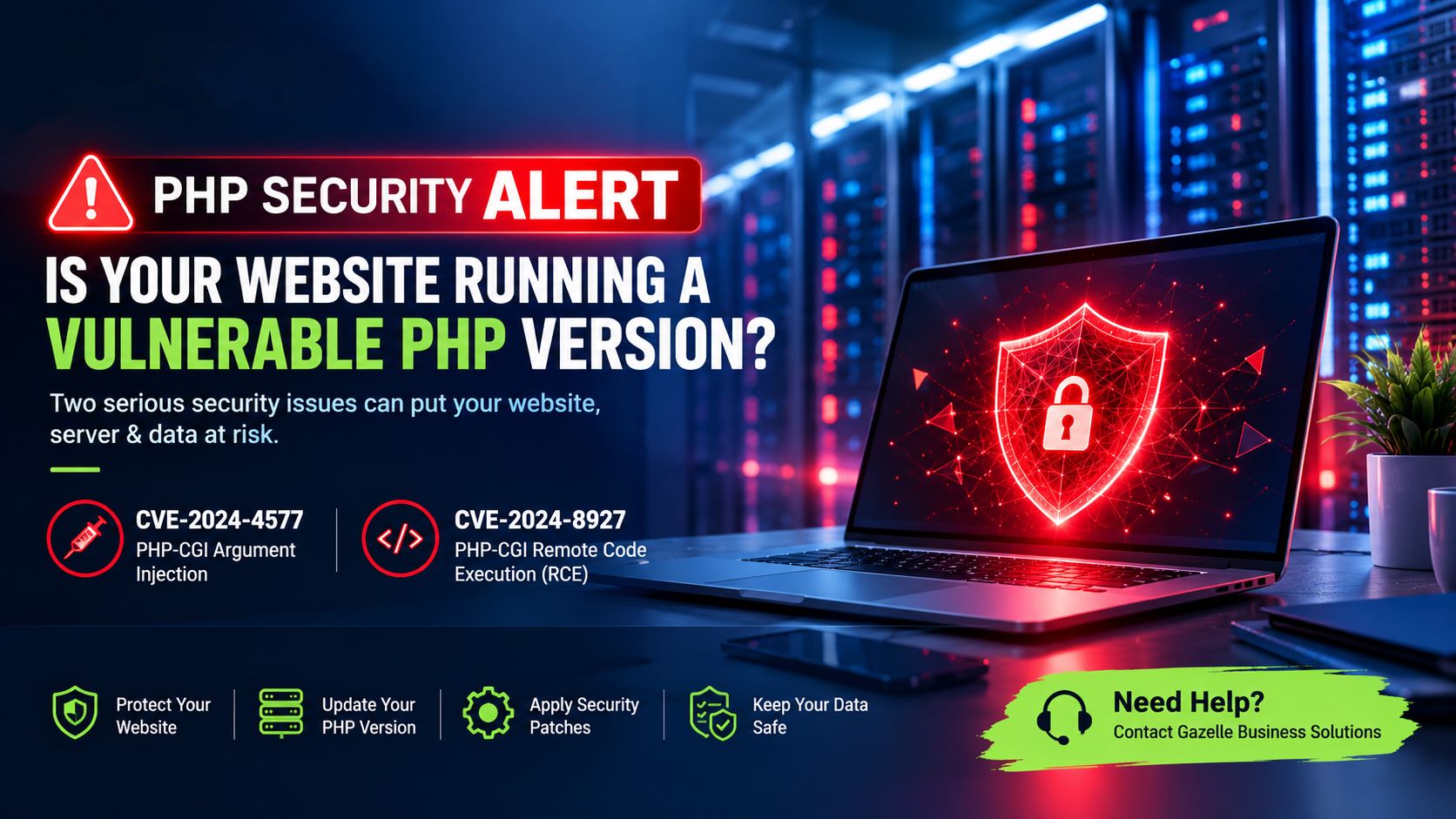
PHP security vulnerability Oman businesses face right now is not a distant technical story. It is a direct risk to every website, web application and customer database running on an unpatched server. Two serious flaws in PHP-CGI, tracked as CVE-2024-4577 and CVE-2024-8927, can let attackers take over servers, read source code or include files they should never reach.
Gazelle Business Solutions has prepared this guide so every Oman website owner can understand the PHP security vulnerability Oman alert, check whether their server is exposed, and fix it fast.
What the PHP security vulnerability Oman alert actually covers
Two separate issues sit behind the alert. Both involve PHP-CGI, an older way of letting a web server run PHP scripts.
CVE-2024-4577, PHP-CGI argument injection (Critical, CVSS 9.8). On Windows servers, a character conversion feature called Best-Fit can cause PHP-CGI to misread certain characters as PHP options. Attackers can use this to reveal script source code or run arbitrary code on the server.
CVE-2024-8927, cgi.force_redirect bypass (High, CVSS 7.5). An attacker can send a crafted HTTP header that tricks PHP-CGI into skipping a safety check. In some configurations this leads to arbitrary file inclusion.
| Item | CVE-2024-4577 | CVE-2024-8927 |
| Severity | Critical (9.8) | High (7.5) |
| Affected | PHP 8.1 before 8.1.29, 8.2 before 8.2.20, 8.3 before 8.3.8 | PHP 8.1 before 8.1.30, 8.2 before 8.2.24, 8.3 before 8.3.12 |
| Fixed in | 8.1.29, 8.2.20, 8.3.8 | 8.1.30, 8.2.24, 8.3.12 |
| Main risk | Code execution on Windows with PHP-CGI | File inclusion through a bypassed CGI safety check |
Older branches such as PHP 7.x and 8.0 are also exposed to the first flaw on Windows and no longer receive patches, so they must be upgraded, not patched. PHP 8.1 reached end of life at the end of 2025, so moving to a supported branch such as 8.3 or newer is the real fix.
Is your website affected by the PHP security vulnerability Oman alert?
Not every Oman website is equally exposed to the PHP security vulnerability Oman alert. The first flaw targets Windows servers running PHP in CGI mode, such as some XAMPP, IIS and Apache setups. Most modern shared hosting runs PHP-FPM or similar, which is not exposed in the same way. Still, never assume. Ask your hosting provider or developer three questions:
- Which exact PHP version are we running?
- Is PHP running in CGI mode?
- Is the server Windows or Linux?
If nobody can answer, treat the website as at risk until it has been checked.
What can happen if the PHP security vulnerability Oman is not fixed
An unpatched server can lead to:
- Attackers taking control of your server and running their own code
- Website data and source code being read, stolen or modified
- Malware or spam pages injected into your website
- Your website becoming slow, blacklisted by search engines or completely offline
- Customer names, phone numbers and order details being exposed
For an Oman retailer, restaurant or clinic, any one of these means lost sales, lost trust and possible responsibility for customer data. For official cyber security guidance in the Sultanate, start with the Information Technology Authority Oman, which hosts the national CERT, and report any suspected compromise promptly.
7 proven steps to master PHP security vulnerability Oman protection
1. Check your PHP version today. Ask your host or look in your control panel. Write down the exact version number, for example 8.2.19, not just “8.2”.
2. Upgrade to a patched, supported version. You need at least 8.1.30, 8.2.24 or 8.3.12, and ideally the latest release of PHP 8.3 or newer, because older branches no longer receive fixes. Test your site on a staging copy first.
3. Review how PHP runs on your server. Move away from PHP-CGI to PHP-FPM, FastCGI or mod_php where possible. This removes the attack path used by both flaws.
4. Apply operating system and web server patches. Update through your hosting control panel or server settings, then restart services after patching.
5. Update plugins, themes and applications. WordPress, Laravel, custom portals and every plugin should be current. An outdated plugin can undo a perfectly patched PHP version.
6. Back up and monitor. Keep a recent off-server backup, review access logs for strange requests, and set up alerts for unexpected file changes.
7. Get a professional security review. A qualified team can confirm your server is not vulnerable, close other weak points and document the fix. Resolving the PHP security vulnerability Oman alert properly takes more than clicking update, so do not guess.
How Gazelle fixes the PHP security vulnerability Oman risk for your business
Gazelle Business Solutions helps Oman companies find and fix exposure quickly, without disrupting daily operations. Our team checks your PHP version and server configuration, upgrades to a supported and patched release, tests your website and applications after the change, and updates plugins and themes. We also set up monitoring and backups so the same PHP security vulnerability Oman problem does not catch you off guard again.
Every fix is documented so you know exactly what changed. If you run a shop website, read our guide on retail website design Oman to see how a professionally built site is designed with security and speed in mind.
Who should act on the PHP security vulnerability Oman alert today
- Businesses with a website, online store or booking portal built on PHP
- Companies running WordPress, Laravel or custom PHP applications
- Organisations hosting on Windows servers or self-managed VPS plans
- Any business that has not updated its server in the last six months
- Owners who do not know which PHP version their website uses
The PHP security vulnerability Oman alert is fixable, and the cost of acting now is far smaller than the cost of a breach. Check your version, upgrade to a supported release and ask for help if anything is unclear.
Need help? Contact Gazelle Business Solutions today. Do not wait for the PHP security vulnerability Oman issue to become a breach.