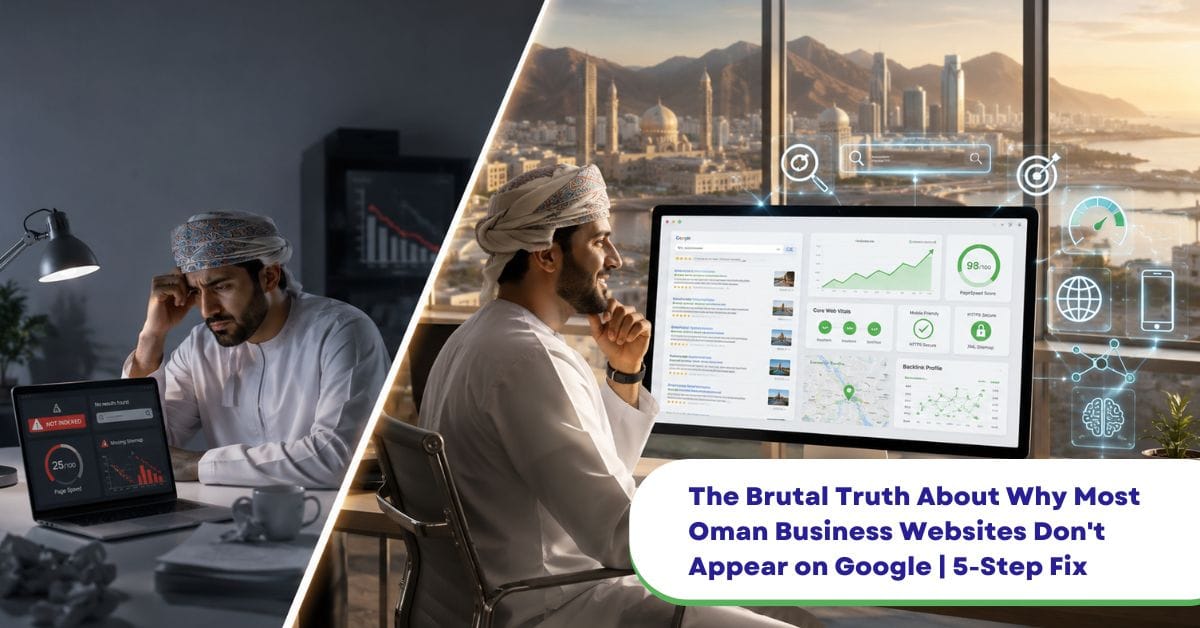
Why Oman business websites don’t appear on Google is one of the biggest frustrations for business owners across Muscat, Sohar, Salalah, Nizwa, and the rest of Oman. You’ve invested in a professionally designed website, purchased a domain, paid for hosting, and even shared your website on social media, but when potential customers search for your products or services on Google, your business is nowhere to be found.
The brutal truth is this: having a website doesn’t guarantee Google visibility. Google doesn’t rank websites simply because they exist or because they look attractive. It ranks websites that demonstrate technical excellence, valuable content, authority, and a great user experience.
Many businesses in Oman unknowingly launch websites with serious SEO issues. As a result, Google either struggles to find their pages or chooses competitors that provide a better experience.
The good news? Every one of these problems can be fixed. In this guide, we’ll uncover the real reasons why most Oman business websites don’t appear on Google and explain the five proven steps to help your website become visible, attract qualified visitors, and generate more enquiries.
Why Oman Business Websites Don’t Appear on Google
If your website isn’t showing in Google’s search results, it’s usually because of one or several of the following issues.
1. Google Doesn’t Know Your Website Exists
Many websites are launched without being properly submitted to Google. If Google hasn’t discovered your pages, they simply won’t appear in search results.
Common causes include:
- No Google Search Console setup
- Missing XML sitemap
- Incorrect robots.txt configuration
- “No Index” accidentally enabled
- Broken internal linking
Without proper indexing, your website is practically invisible.
2. Your Website Targets the Wrong Keywords
One of the biggest SEO mistakes is creating pages around company language instead of customer searches.
For example, many businesses create pages titled:
- Solutions
- Services
- Products
- Welcome
But customers actually search for:
- Website Design Company in Muscat
- ERP Software Oman
- Digital Marketing Agency Oman
- Best SEO Company in Oman
If your content doesn’t match what people search for, Google has little reason to rank it.
3. Your Website Is Slow
Google wants users to enjoy fast browsing experiences.
Unfortunately, many business websites suffer from:
- Large uncompressed images
- Cheap hosting
- Too many plugins
- Poor coding practices
- Heavy page builders
- Unoptimized JavaScript and CSS
A slow website increases bounce rates and reduces search visibility.
4. Your Content Doesn’t Help Users
Many websites only talk about themselves.
Visitors don’t want pages filled with marketing slogans; they want answers.
Google rewards websites that educate users, solve problems, answer questions, and provide genuine value.
If every page simply says “We are the best,” Google has very little useful information to rank.
5. You Have Almost No Website Authority
Google treats backlinks as votes of confidence.
If reputable websites never mention or link to your business, Google has fewer trust signals.
Authority grows through:
- Helpful blog content
- Industry partnerships
- Business directories
- Customer mentions
- Local citations
- High-quality backlinks
Without authority, even good websites struggle to compete.
The 5-Step Fix
The good news is that these issues can all be solved with a structured SEO strategy.
Step 1: Make Sure Google Can Crawl and Index Your Website
Before thinking about rankings, make sure Google can actually find your website.
Start by:
- Connecting to Google Search Console
- Submitting an XML sitemap
- Checking robots.txt
- Removing accidental “No Index” tags
- Fixing crawl errors
- Monitoring indexing reports
This should be your first SEO priority because pages that aren’t indexed cannot rank.
Step 2: Target the Keywords Your Customers Actually Search
SEO starts with understanding search intent.
Instead of creating generic service pages, build pages around real customer searches.
Examples include:
- Web Design Company Oman
- Mobile App Development Muscat
- ERPNext Implementation Oman
- Restaurant Website Development Oman
- Corporate Branding Oman
Each page should answer one primary search intent and provide useful, original content.
Avoid stuffing keywords unnaturally. Write for people first and search engines second.
Step 3: Improve Technical SEO and Website Performance
Technical SEO forms the foundation of long-term rankings.
Every business website should include:
- HTTPS security
- Fast hosting
- Mobile responsiveness
- Optimized images
- Schema Markup
- Canonical URLs
- Core Web Vitals optimization
- Clean URL structure
- Internal linking
- Breadcrumb navigation
Even the best-written content will struggle if the website has technical problems.
Regular SEO audits help identify hidden issues before they affect rankings.
Step 4: Publish Helpful Content Regularly
Google rewards websites that consistently provide fresh, useful information.
Instead of publishing promotional content, answer your customers’ questions.
Examples include:
- How much does a website cost in Oman?
- Why is my website not ranking on Google?
- How to improve local SEO in Muscat
- Website maintenance checklist
- Benefits of ERP software for SMEs
Educational content positions your business as an expert while increasing opportunities to rank for long-tail keywords.
You should also connect related articles together. For example, if your business is adopting digital transformation, you can explore our ERPNext implementation guide to understand how integrated ERP systems improve business efficiency and support sustainable growth.
Step 5: Build Local Authority and Trust
Google wants to recommend businesses that people trust.
Build credibility by:
- Optimizing your Google Business Profile
- Collecting genuine customer reviews
- Listing your business in trusted Omani directories
- Earning backlinks from industry websites
- Publishing case studies
- Sharing customer success stories
The more trust signals your business earns, the stronger your long-term search visibility becomes.
SEO isn’t about shortcuts; it’s about building authority over time.
Common SEO Mistakes Omani Businesses Make
Many businesses unknowingly damage their rankings by making avoidable mistakes, including:
- Copying content from competitors
- Publishing thin service pages
- Ignoring image optimization
- Using duplicate page titles
- Forgetting meta descriptions
- Not updating old content
- Poor internal linking
- No structured data
- Slow mobile performance
- Never checking Google Search Console
Fixing these issues alone can significantly improve your website’s visibility.
Why This Matters More Than Ever
Oman’s digital economy is growing rapidly, and more consumers begin their buying journey on Google before contacting a business.
Whether someone is searching for a restaurant, engineering consultant, medical clinic, construction company, retail shop, or software provider, they usually compare multiple businesses online before making a decision.
This aligns with the digital transformation goals of Oman Vision 2040, which encourages innovation, technology adoption, and a stronger digital economy. Businesses that invest in SEO today will be better positioned to attract future customers and remain competitive.
Official Oman Vision 2040:
https://oman2040.om
The brutal truth is that most business websites don’t fail because they’re unattractive; they fail because they’re invisible.
Google doesn’t reward websites simply for existing. It rewards websites that are technically sound, fast, helpful, trustworthy, and optimized around what customers are actually searching for.
If your website isn’t appearing on Google, don’t assume SEO doesn’t work. Instead, audit your website, fix the underlying issues, and follow the five-step strategy outlined in this guide.
SEO is a long-term investment, but when done correctly, it becomes one of the most cost-effective ways to generate consistent traffic, qualified leads, and sustainable business growth.
If you’re serious about growing your business online in Oman, now is the time to stop treating your website like a digital brochure and start treating it as your most valuable marketing asset.